
Centrifugal or self-priming pump: which one you need
FZ INOX technical guide · October 2026 · with the real curves of the pumps we build in Thiene, Italy
In short. The choice depends on two things: where the liquid is compared with the pump and whether the liquid contains air. A centrifugal pump pushes liquid well but cannot draw air: it must receive the liquid already full, from a higher tank or under pressure. A self-priming pump removes the air from the suction pipe by itself: it draws liquid even from a lower level, copes with air and foam and restarts after stops. In exchange, with the same motor, it gives less head and less flow. If the liquid comes from above and without air you need a centrifugal pump; if it must be drawn from below or carries air you need a self-priming pump.
The difference: priming
To pump, a pump must have its casing and suction pipe full of liquid: it is then primed. A centrifugal pump needs the liquid to reach it already full, by gravity or under pressure. A self-priming pump gets there by itself: at start-up it removes the air from the suction pipe until the liquid rises up to it. That is why it can also work with suction lift, that is, higher than the liquid it draws.
Why a centrifugal pump cannot draw air
The impeller gives the fluid a head in metres, and those metres do not change with the density of the fluid: the pressure does (we explain it in the guide to the pump curve). With water our FZ-CP30 with Ø155 impeller gives 30 m at zero flow, about 2.9 bar.
With the casing full of air the same impeller still gives 30 m, but of air, which is over 800 times lighter than water: 3.5 millibar, enough to lift the water in the pipe by less than 4 cm. The impeller turns, but the liquid does not rise.
For the same reason a centrifugal pump that receives air or foam while running loses flow, gets noisy and can lose its prime: it stops pumping and the mechanical seal runs dry.
The centrifugal pump
It must be installed with flooded suction: the liquid reaches the inlet by gravity, from a tank higher than the pump, or under pressure from another machine. In these conditions it is the simplest solution and the most efficient one: compact casing, no extra parts for priming, high flows and heads with small motors.
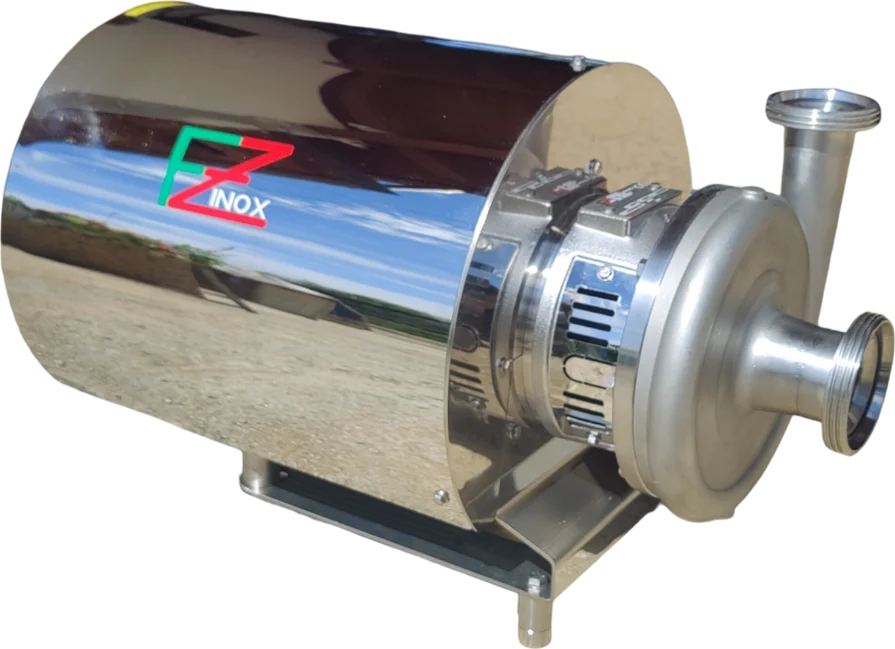
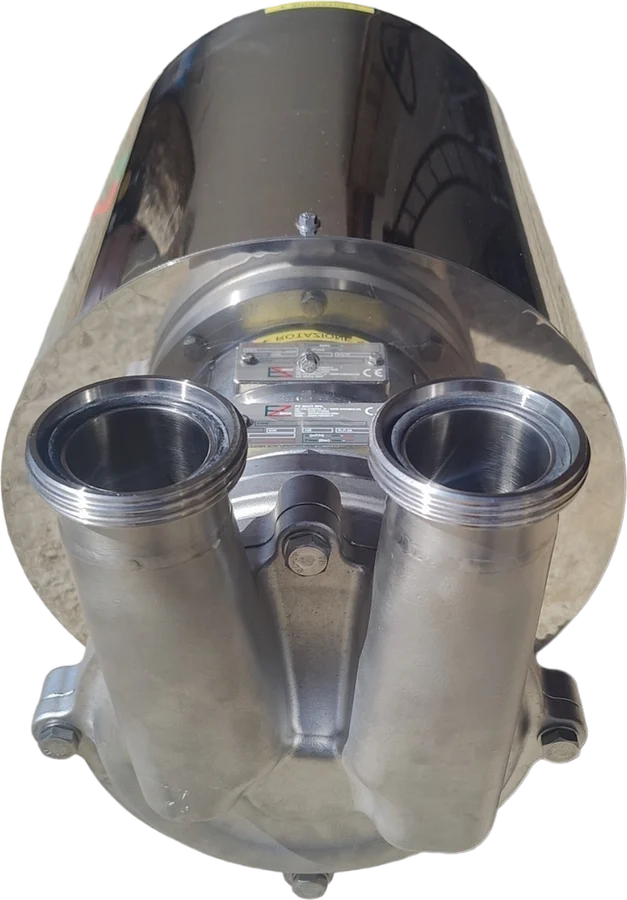
Our FZ-CP pumps run at about 2,900 rpm, with open impellers from Ø105 to Ø180 mm and motors from 0.55 to 7.5 kW: they reach 48 m³/h and 45 m of head, with a maximum discharge pressure of 4.5 bar at 50 Hz.
The self-priming pump
Inside, a self-priming pump also pumps liquid. The difference is that it keeps some liquid in the casing even when it is stopped. At start-up the impeller mixes that liquid with the air coming from the suction pipe and pushes the mixture towards the outlet: the air leaves, the liquid falls back and circulates again. Turn after turn the air leaves the suction pipe and the liquid, pushed by atmospheric pressure, takes its place. From then on the pump runs full.
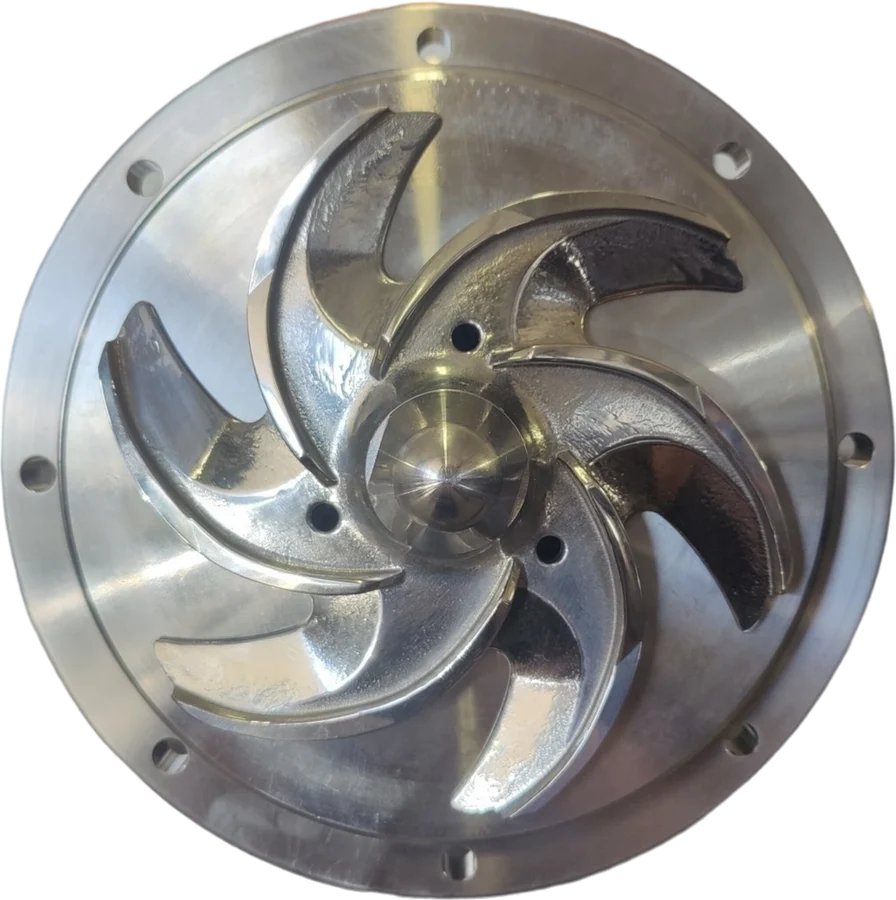
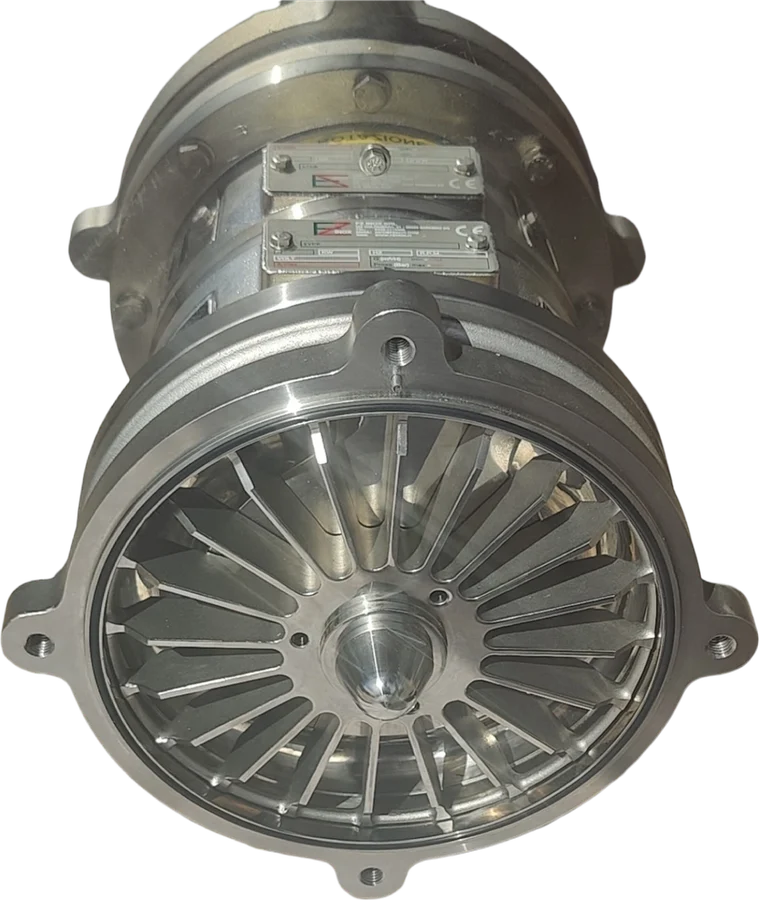
Manufacturers get there in different ways. Self-priming centrifugal pumps have a chamber that separates the air from the liquid, often with a non-return valve on the suction. Liquid ring pumps, widely used for CIP return, have an impeller with many closely spaced blades and a shaped casing: the liquid forms a ring against the walls, and between one blade and the next, chambers open and close that draw the air in and push it out.
Our FZ-SP is a liquid ring pump. It draws liquid even from below its own level, up to about 7 m, restarts by itself after an interruption without manual re-priming, and is made for foaming liquids and intermittent work. It runs at about 1,450 rpm, half the speed of an FZ-CP, with a Ø192 impeller and 3 or 4 kW motors: up to 24 m³/h and 26 m of head.
Centrifugal and self-priming compared
| FZ-CP centrifugal | FZ-SP self-priming | |
|---|---|---|
| Suction | Flooded: the liquid comes from above or under pressure | Also from below, up to about 7 m |
| Air and foam | Loses flow, can lose its prime | Handles them |
| Stops | Restarts if the liquid is still in the suction | Restarts by itself, no manual re-priming |
| Type | Centrifugal, open impeller | Liquid ring |
| Speed | ≈ 2,900 rpm | ≈ 1,450 rpm |
| Motors | 0.55 to 7.5 kW | 3 and 4 kW |
| Max flow | 48 m³/h | 24 m³/h |
| Max head | 45 m (4.5 bar at 50 Hz) | 26 m |
| At 10 m³/h with 3 kW | 28 m (FZ-CP30 Ø155) | 10 m (FZ-SP30) |
| 60 Hz curves | Measured | In preparation |
Same motor, different curves
Our real curves show what self-priming costs. At 10 m³/h, with the same 3 kW motor, the FZ-CP30 with Ø155 impeller gives 28 m and the FZ-SP30 10 m. With 4 kW the FZ-CP40 with Ø160 impeller gives 32 m and the FZ-SP40 19 m.
The same duty as the FZ-SP30, 10 m³/h at 10 m, is done with flooded suction by a 1.1 kW FZ-CP11 with Ø115 impeller: about 11.5 m at 10 m³/h, with the motor reaching full load only at 14 m³/h. That is why a self-priming pump is chosen when it is really needed: where a centrifugal pump will do, it does the same job with a smaller motor.
Which one you need, case by case
You need a centrifugal pump when:
- the liquid comes from a tank higher than the pump, or under pressure;
- the liquid carries no air or foam;
- you need high flows or heads: CIP supply, feeding pasteurisers and heat exchangers, long transfers, recirculation;
- the pump runs for long periods without stopping.
You need a self-priming pump when:
- the liquid must be drawn from below the pump: drums, tankers, pits, underground tanks;
- the liquid contains air or foam;
- the tank must be emptied to the bottom, when air gets in at low level;
- the suction pipe empties between transfers, or the work is intermittent;
- the liquid comes back mixed with air, as in CIP return.
In CIP cleaning both are at work
In a CIP system the cleaning solution leaves a tank and is pushed through the pipes and tanks to be cleaned: that is a job for a centrifugal pump, which must give flow and pressure all the way to the end of the line. The return is different: the solution leaves the bottom of the tanks mixed with air, and a centrifugal pump would lose its prime. That is why the return is done with a self-priming pump, which takes the solution back even when it arrives with air and empties the tank and the line.
Hygienic design for food
In the food industry both must be of hygienic design: they are cleaned in place with CIP, without dismantling, and leave no spots where the product can stagnate. Our FZ-CP and FZ-SP pumps have all product-contact parts in polished AISI 316L, DIN 11851 connections as standard (Tri-Clamp, SMS and flanges on request) and a version with an IP69-K motor for areas washed at high pressure.
Centrifugal and self-priming pumps are for liquids: milk, whey, wine, beer, juices, process water, cleaning solutions. With very thick products or products with pieces, such as creams and purées, neither is the right choice: you need positive displacement pumps.
How to choose: five questions
- Where is the liquid compared with the pump? Higher or under pressure: centrifugal. Lower: self-priming; the FZ-SP draws from up to about 7 m.
- Does the liquid contain air or foam? If so, self-priming.
- Must the tank be emptied to the bottom, or does the suction pipe stay empty between jobs? Self-priming.
- How much flow and head? Among our pumps, above 24 m³/h or 26 m you need an FZ-CP. The duty point is chosen on the curve: we explain how in the guide to the pump curve.
- What product, at what temperature? Viscosity and temperature change the performance and the suction margin: tell us and we choose the pump on those data.
Mistakes to avoid
- A centrifugal pump above the liquid level: it does not start, or it starts after manual filling and loses its prime at the first air bubble.
- Running a pump dry: the mechanical seal is cooled by the liquid. This applies to self-priming pumps too, which must be filled at first start.
- Throttling the suction to adjust the flow: the inlet pressure drops and the pump cavitates. Adjust on the discharge or with an inverter, as we explain in the guide to the pump curve.
- Choosing a self-priming pump “to be safe” where a centrifugal one will do: with the same motor it gives less head and less flow.
Frequently asked questions
What does self-priming pump mean?
That the pump primes itself: at start-up it removes the air from the suction pipe and draws the liquid in, even from a lower level, without anyone having to fill the pipe every time.
How can I tell if a pump is self-priming?
The manufacturer’s data sheet says so: if the pump is self-priming, it is written there. If it is not, treat it as a standard centrifugal pump, to be installed with flooded suction.
Can a centrifugal pump draw liquid from a lower level?
A standard centrifugal pump cannot: it must receive the liquid already full, from a higher tank or under pressure. If the liquid is below the pump you need a self-priming pump.
Does a self-priming pump need filling at first start?
Yes, and this applies to our FZ-SP too: it needs liquid in the casing to prime, so at first start, or after it has been drained, the casing must be filled. After that it keeps it between stops. No pump should run dry: the mechanical seal is cooled by the liquid.
Why is CIP return done with a self-priming pump?
Because the solution leaves the bottom of the tanks mixed with air. A centrifugal pump would lose its prime; a self-priming pump keeps pumping and empties the tank and the line.
How deep can a self-priming pump draw from?
The liquid in the pipe is pushed up by atmospheric pressure: with cold water at sea level the theoretical limit is about 10 m. In practice it is less, because the friction losses of the suction pipe take away margin: our FZ-SP draws from up to about 7 m. With hot liquids the margin shrinks further, because of the risk of cavitation. Tell us the height, the pipe, the product and the temperature and we confirm the duty point.
Can I use a self-priming pump instead of a centrifugal one?
Yes, but with the same motor it gives less head and less flow. On our curves, at 10 m³/h with 3 kW, the FZ-CP30 gives 28 m and the FZ-SP30 10 m. If the liquid comes from above and without air, the centrifugal pump is the better choice.
Do FZ-SP pumps run at 60 Hz?
The FZ-SP range is published at 50 Hz, about 1,450 rpm; 60 Hz tests are in preparation. For 60 Hz supplies write to us and we confirm the duty point. FZ-CP pumps already have curves measured at both 50 and 60 Hz.
Not sure which one you need? Tell us where you draw the liquid from, where you send it, what the product is and how much flow you need: we tell you whether an FZ-CP will do or you need an FZ-SP, and we build it in our workshop in Thiene, Italy.