
Powder dissolver (triblender): how it works and how to choose one
FZ INOX technical guide · October 2026 · with the real data of the triblenders we build in Thiene, Italy
In short. A powder dissolver, or triblender, dissolves powders in a liquid without lumps. A centrifugal pump drives the liquid through a venturi, which creates a vacuum under the hopper and draws the powder straight into the flow: every grain is wetted the moment it goes in. You choose it on three numbers: how much powder per hour, how much liquid and how thick the product becomes.
Why powder forms lumps
Poured on top of a tank, powder floats. The outer layer gets wet first and forms a skin that traps the still-dry powder inside: that is a lump. The heavier part sinks and settles. The tank agitator stirs the whole volume, but it takes a long time to break up lumps that have already formed.
A powder dissolver works the other way round: it does not put the powder on the liquid, it brings it into the liquid, a little at a time, where the flow is fastest. So every grain is wetted at once. Operators also stop tipping sacks into an open tank: the powder goes in through the hopper and less dust rises in the room.
How a triblender works
- The liquid flows. The centrifugal pump, which in our FZ-TB runs at about 2,900 rpm, pushes the liquid through the venturi, a tube inside a tube above the pump inlet.
- A vacuum forms. The fast liquid in the venturi lowers the pressure right under the hopper: that is the venturi effect.
- The powder is drawn in. When the butterfly valve at the bottom of the hopper opens, the powder falls into the venturi and meets the liquid near the impeller, where it is wetted and dispersed.
- The mixture leaves. The pump sends liquid and powder out through the outlet, to the tank or to the next step.
In our FZ-TB the vacuum in the venturi also draws in the liquid: no extra feed pump is needed. The hopper is a 50-litre cone at 60°, spun on a lathe, seamless and polished inside; the butterfly valve has an external handle and sets how much powder goes in.
Around the impeller there is a perforated ring. It is there for products that tend to form lumps: the impeller throws them hard against the ring, and the lumps break up there.
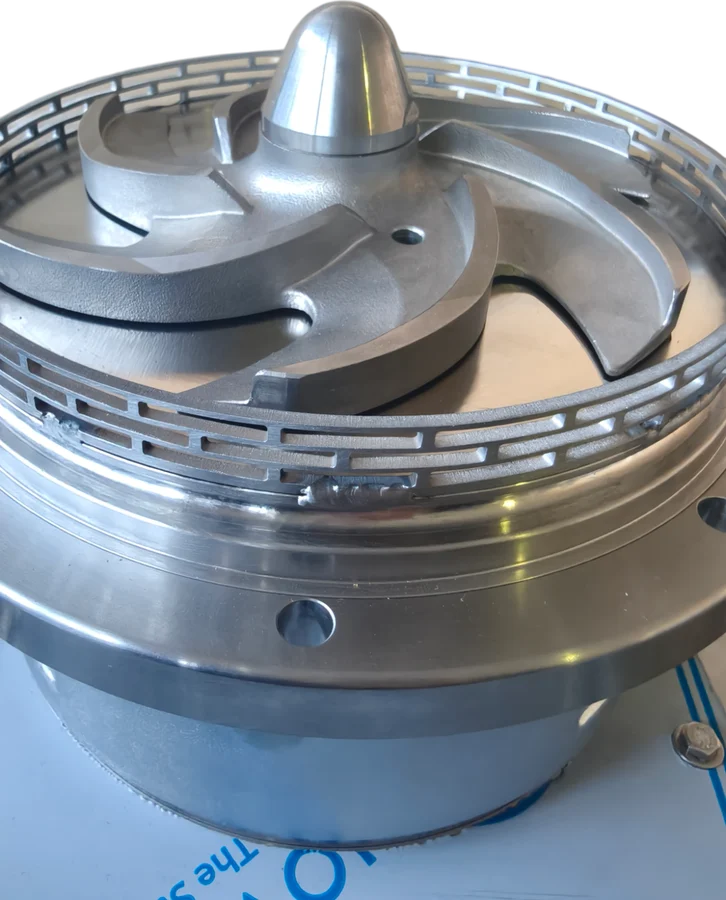
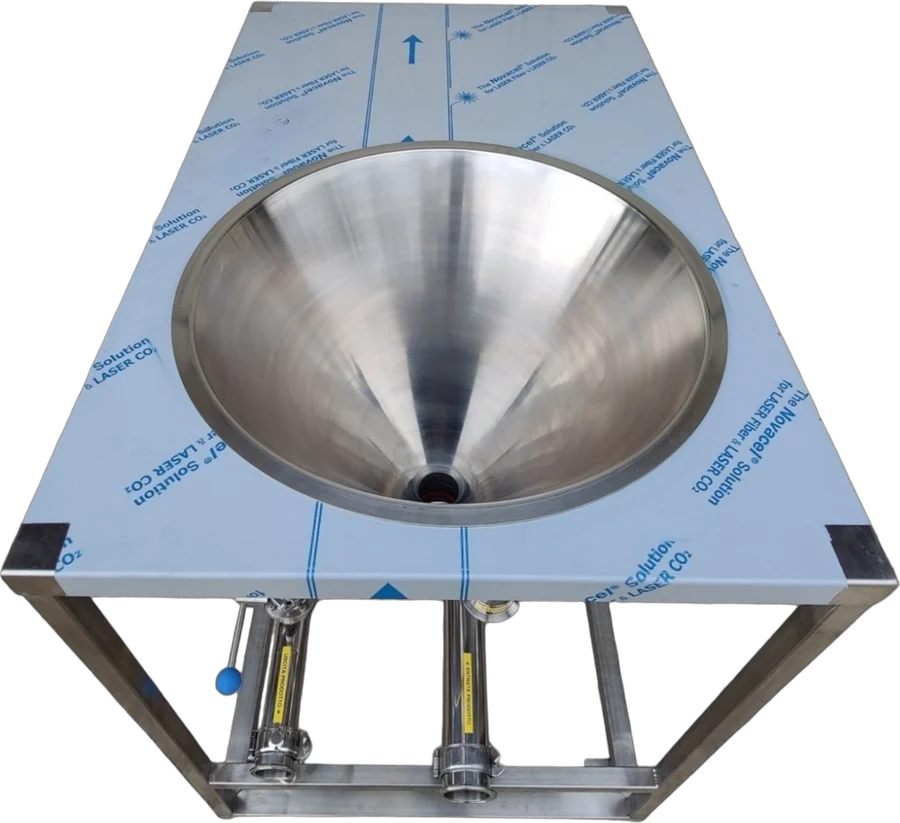
Recirculation or in-line
The most common way is recirculation on a tank: the triblender takes the liquid from the bottom, dissolves the powder in it and sends it back into the tank from the top. You load powder for as long as needed, then let it run a little longer so the mixture becomes uniform throughout the tank.
Alternatively the triblender works in-line: the product leaves already dissolved and goes straight to the next step. If it has to travel far or against pressure, a booster pump is added on the outlet.
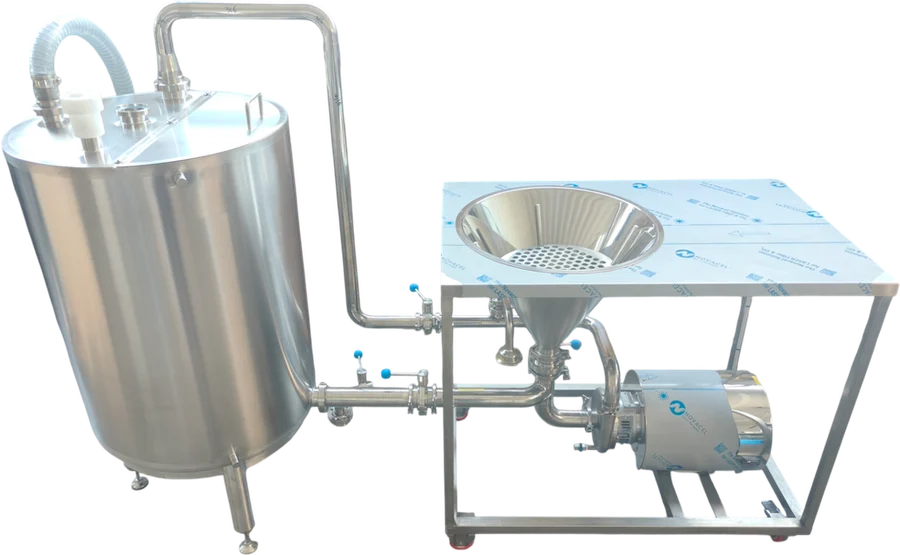
How much powder it dissolves per hour
It depends on the powder, the temperature and how concentrated the solution becomes. These are the indicative values of our three FZ-TB sizes, self-fed, at 50 Hz. Degrees Brix measure dissolved sugar: 25 °Brix means 25 g of sugar in every 100 g of solution.
| Model | Motor | Liquid recirculation | Sugar 25 °Brix | Milk powder 20% | Thickener 400 cP |
|---|---|---|---|---|---|
| FZ-TB40 | 4.0 kW | 30 m³/h | 1,800 kg/h | 1,000 kg/h | 400 kg/h |
| FZ-TB55 | 5.5 kW | 35 m³/h | 2,800 kg/h | 2,000 kg/h | 450 kg/h |
| FZ-TB75 | 7.5 kW | 40 m³/h | 4,500 kg/h | 3,000 kg/h | 500 kg/h |
The number that matters most is the last one: with a thickener that brings the solution to 400 cP, capacity drops to 400–500 kg/h, even with the largest motor. The thicker the product becomes, the less powder goes in per hour.
Which powders dissolve, and which do not
With a triblender you prepare sugar syrups, milk and whey reconstituted from powder, cocoa and sugar in milk, milk flours and starches, brines, yogurt pre-mixes, casein and caseinates.
It is not suitable for xanthan gum and thickeners that hydrate instantly: the solution thickens within seconds, stops flowing in the pipes and the venturi blocks, until the machine is dismantled and cleaned. Thickeners of moderate viscosity stay within the working range. If you need to dissolve a product of this kind, talk to us first.
How to choose a powder dissolver
- Which powder and how much per hour, in kg/h. The stated capacity applies to one specific powder: compare it with yours.
- How much liquid and what final concentration: the batch volume or the in-line flow.
- How thick the product becomes: this is the figure that lowers capacity the most.
- Recirculation or in-line, and where the product goes: if far or against pressure, you need the booster pump.
- How the powder arrives: in sacks, with the table holding them at working height; if the powder bridges in the hopper, with the vibrator.
- Manual or automatic: pneumatic valves, minimum and maximum level probes, an inverter on the motor.
- One station or several lines: on the table it stays in one place, on the trolley it moves between tanks and rooms.
- How the room is cleaned: where it is washed at high pressure there is the version with an IP69-K motor.
Mechanical seal and options
As standard our FZ-TB have an internal long-tail mechanical seal, with tungsten carbide and carbon faces and EPDM gaskets. With products that dry or crystallise on the seal faces, such as concentrated sugar syrups, a double flushed seal is available, washed continuously from outside.
Standard connections are Clamp: 3" inlet and 2" outlet. Other options: DIN or SMS connections, drain, hopper protection mesh, vibrator, pneumatic valves, level probes, swivel castors or adjustable feet, inverter, custom stainless control panel.
CIP cleaning
The hardest part of a powder dissolver to clean is the powder path: valve, venturi and pump, where residues settle. On our FZ-TB you remove the hopper and connect, in its place, the recirculation pipe already fitted on the outlet. When the hopper valve is opened the cleaning solution runs through the whole circuit and the triblender is cleaned together with the rest of the line, without dismantling anything. It is standard on every triblender.
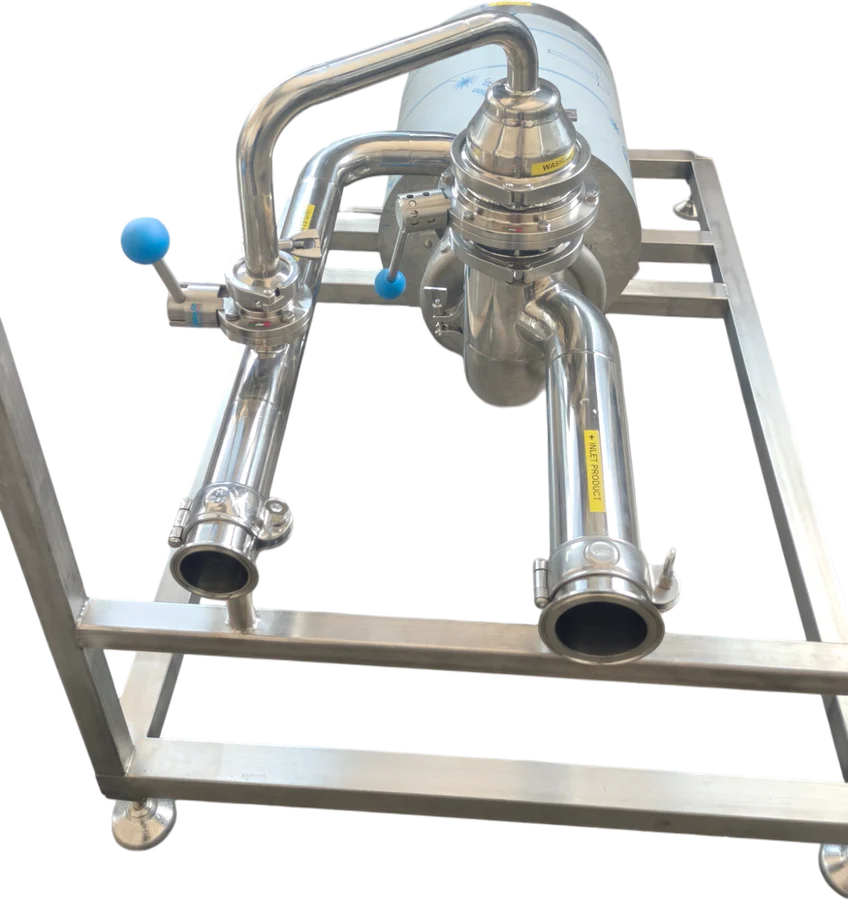
Mistakes to avoid
- Pouring the powder straight into the tank “to save time”: lumps, deposits on the bottom and long mixing times.
- Using it with instant thickeners such as xanthan: the venturi blocks and the machine has to be dismantled.
- Counting on the sugar capacity with a thick product: at 400 cP capacity drops to a quarter or less.
- Letting the hopper run empty with the valve open: the pump draws in air and the product foams.
Frequently asked questions
What is a powder dissolver?
It is a machine that dissolves or disperses powders in a liquid without lumps. In the food industry the most common type is the triblender: a centrifugal pump with a venturi and a hopper, which draws the powder straight into the liquid flow.
Are a triblender and a powder dissolver the same thing?
The triblender is one type of powder dissolver: the one based on a centrifugal pump, with a venturi and a hopper. There are other kinds too, for example with a high-speed agitator inside the tank.
Does the triblender need a feed pump?
Our FZ-TB does not: the vacuum in the venturi draws in both the powder and the liquid. If the product has to travel far or against pressure, a booster pump is added on the outlet.
How much powder does it dissolve per hour?
It depends on the powder, the temperature and the concentration. With sugar up to 25 °Brix our FZ-TB40 dissolves up to 1,800 kg/h, the FZ-TB55 2,800 and the FZ-TB75 4,500. With milk powder at 20%: 1,000, 2,000 and 3,000 kg/h. These are indicative values, at 50 Hz.
Can it be used with xanthan gum?
No. Xanthan and thickeners that hydrate instantly thicken the solution within seconds: the product stops flowing, the venturi blocks and the machine has to be dismantled and cleaned. Thickeners of moderate viscosity, up to about 400 cP, stay within the working range.
Can it be cleaned in place (CIP)?
Yes, as standard: you remove the hopper, connect the recirculation pipe to the outlet and the cleaning solution runs through the pump, the venturi and the valve, without dismantling anything.
What powder do you need to dissolve? Tell us the powder, how much per hour, in which liquid and at what concentration: we choose the right size and build the triblender in our workshop in Thiene, Italy.