
Stainless steel tanks,
built around the process
Small tanks, drawn around what has to go inside them: the shape of the bottom, where it drains, how it opens, how it is heated, what it stands on. There is no catalogue to pick the nearest model from — we start from the product and from the place the tank has to fit.
How much goes in
The litres, before you write to us
You already have the dimensions in your head, or you have already taken them in the space the tank has to fit into: the diameter if it is round, the two sides if it is square. Here you see straight away how many litres come out, and how they change if the bottom is conical instead of flat.
Rectangular tanks stay on a flat bottom here: conical and sloped bottoms on a square base are bespoke geometry, and a number produced here would promise a precision that is not there.
These are internal dimensions, not overall size. On a tank with a 3 mm wall that is six millimetres off the diameter: a few litres, but they count once a measured recipe goes in.
The choices
Nothing is standard, because nothing is off the shelf
We have no standard tank to start from, and no house steel either. Every item below is a decision we take with you, looking at your product and your space — the fitting included, which is the one on your line and not one we impose.
Steel
- AISI 304 — the norm in dairy
- AISI 316 — where there are chlorides
- chosen on the product, together
Finish
- Polished
- Satin
Fittings
- The ones on your line — not ours
Shape
- Round — when the product has to be stirred
- Square
- Rectangular — square and rectangular: when it stands still, more litres, flat bottom
Bottom
- Flat — every shape
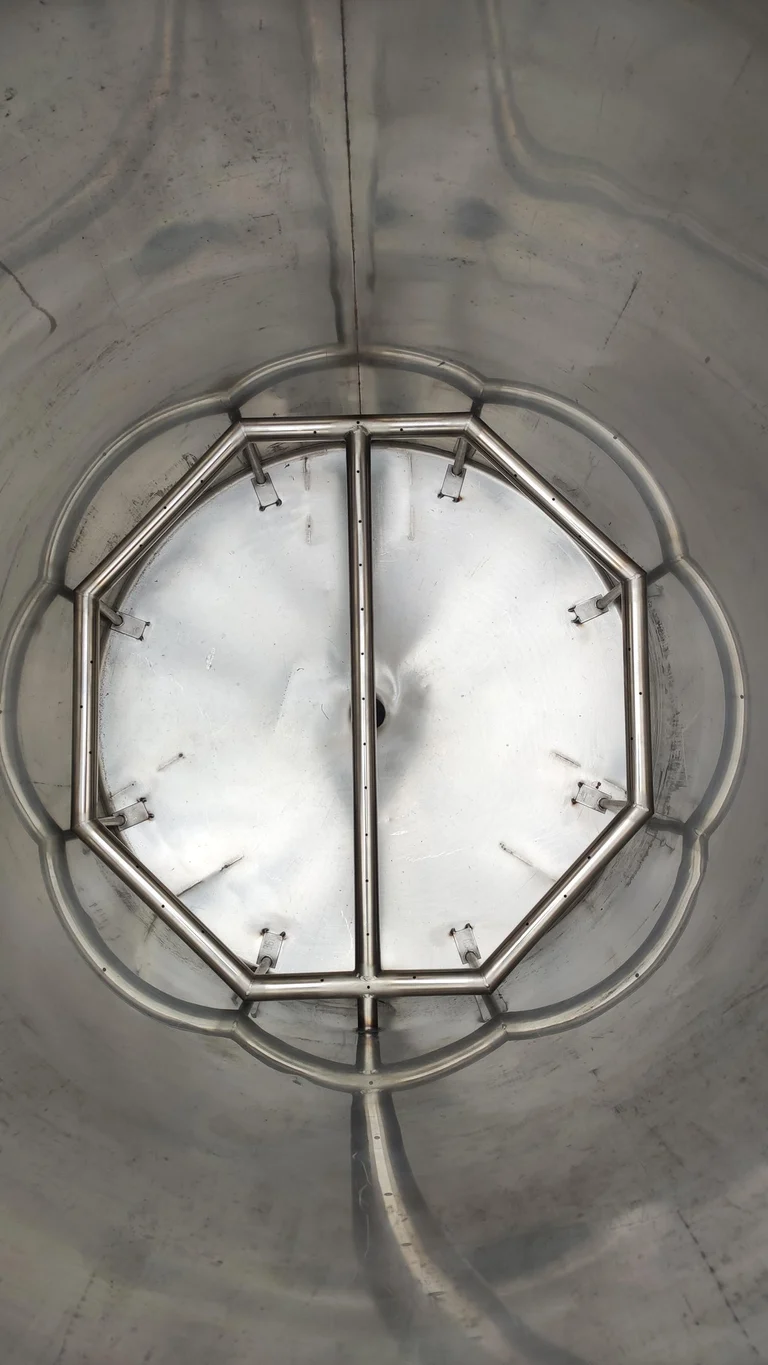
- Conical — round only, drains to the last drop
- Sloped — round only, channels to the outlet
Outlet
- Central
- Side
Lid
- Hinged
- With manway
Standing on
- Adjustable feet
- Castors — if it has to move
- Load cells — if it has to weigh
Instruments
- Agitators, probes, thermowells
- Load cells
- we fit what you ask for
Temperature
- Pillow-plate jacket — also called trapcold; heats and cools
- Insulation — holds
- Single wall — no jacket, no insulation
Stirring
- Agitators
- Emulsifier
Inside
What turns inside the tank
Agitators
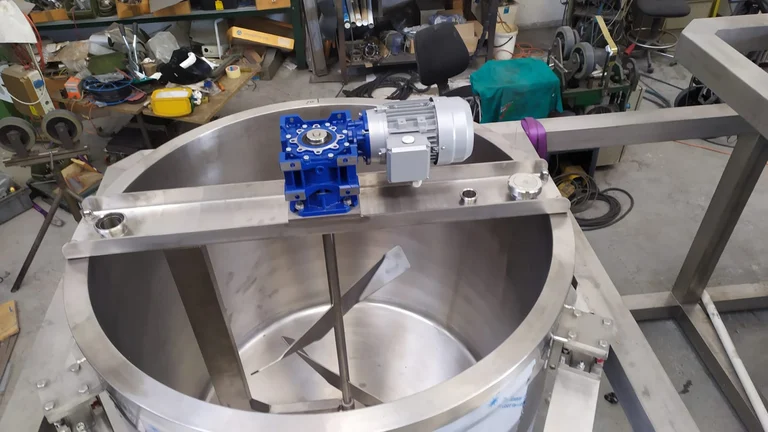
To keep the product moving and uniform. It is sized on the viscosity of what goes in, not on the volume of the tank: two identical tanks with different products want different agitators.
Emulsifier
For delicate emulsions and for work where fineness counts more than speed.
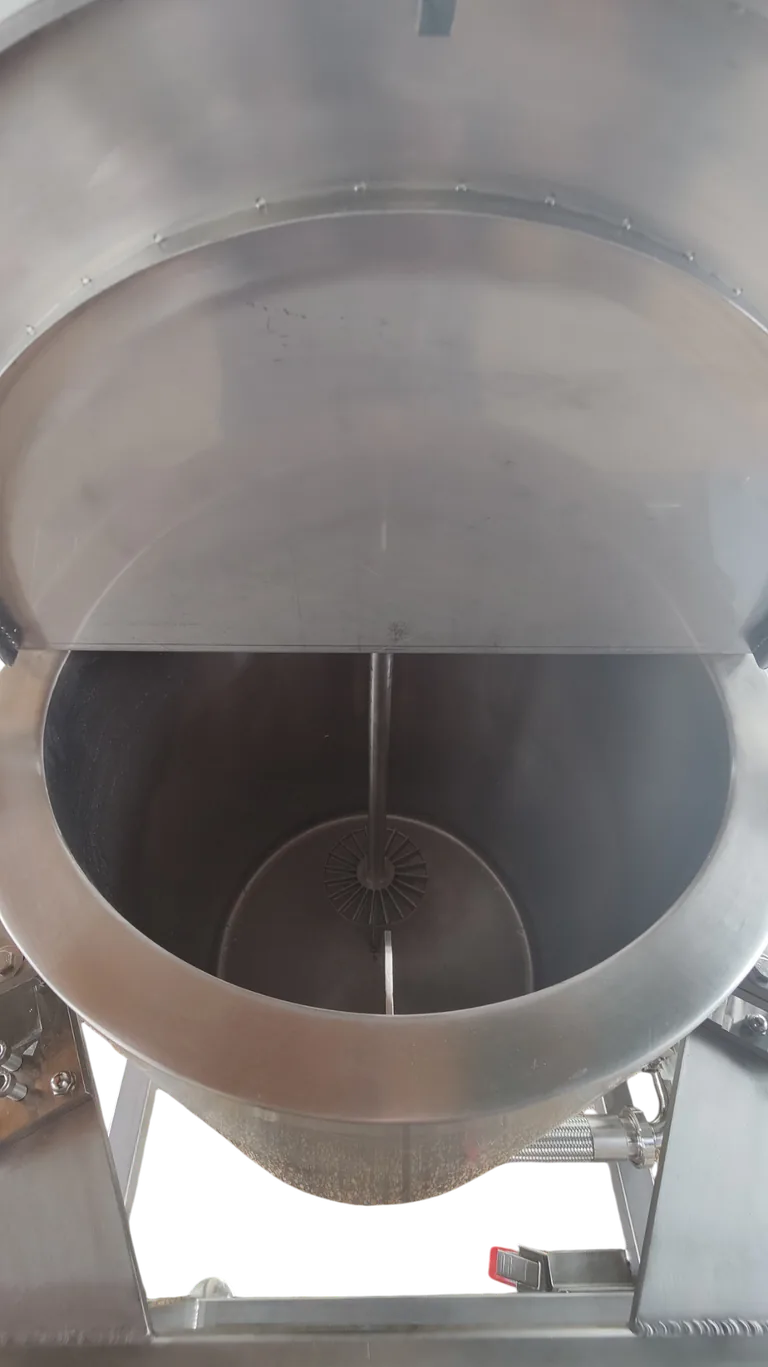
When square pays
Where nothing is stirred, litres are gained
The square tank belongs where no agitator is needed: CIP wash tanks, storage for products that stand still, process water. There a round shape brings no advantage and costs capacity — the capacity lost in the corners the circle does not occupy.
For the same footprint, a square tank holds about a quarter more product. On a wash or storage tank that is not a detail: it is one tank fewer to buy, or one water change fewer to run.
The calculator above, when you choose the square, tells you how many litres a round tank would hold in the same footprint. The difference is what you gain.
Heating and cooling
The pillow-plate jacket
Two sheets laser-welded along a pattern of spots, then inflated: between them a maze of pillow-shaped channels appears, and hot water, glycol water or steam runs through it. It is the same idea as a heat exchanger, wrapped around the tank instead of set in the line.
Why it beats a pipe coiled on the wall: the channels force the fluid to change direction continuously, and a fluid that turns exchanges far more than a fluid running straight. The exchange surface is also spread over the whole wall, so the temperature is uniform and there are no hot spots near the pipe and cold ones away from it.
The other advantage shows up on the bill: the channels hold little fluid. Little glycol water to cool means less work for the chiller, and shorter response times when the temperature has to change.
In the workshop and in catalogues you also hear it called trapcold, after the trade name it spread under, or pillow plate. It is the same thing: a pillow-plate jacket.
Weighing instead of measuring
Load cells
Level lies when the product foams, when it is thick, when it clings to the walls. Weight does not. With load cells under the feet the tank becomes a scale: you dose in kilograms, you know how much went in and how much came out, and you do not have to trust where the float stops.
It makes sense when the tank is there to dose a recipe, not only to hold it.
Level
Float or probes
Two ways of knowing where you are. The float is simple, mechanical, and has nothing to calibrate. Probes give precise thresholds and lend themselves to starting and stopping something on their own. The choice depends on the product and on how automatic everything around it has to be.
Together with our machines
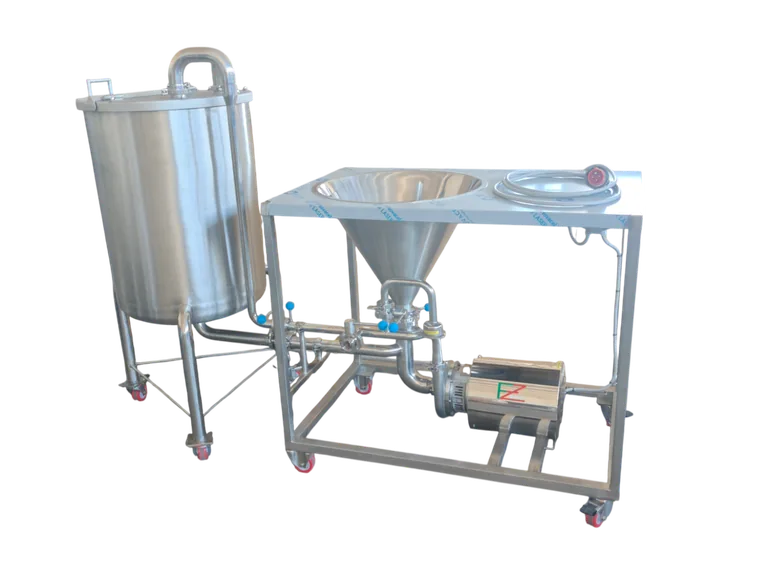
The triblender tank
The triblender dissolves powder into liquid, but the solution has to sit somewhere: we build that tank ourselves, together with the machine. That is where the recipe takes shape, and from there it is pumped to the filler or wherever it is needed on the line.
The advantage of having them born together is that there is nothing to make fit afterwards: heights, fittings and capacity are decided looking at the same machine, not at two different catalogues.
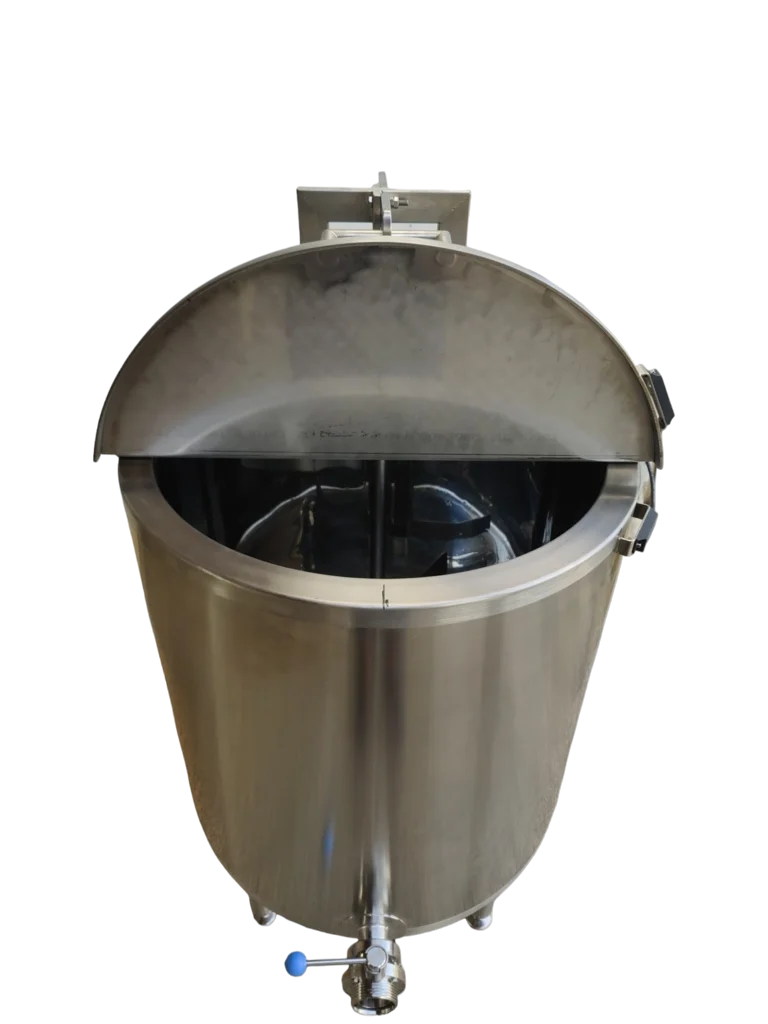
Balance tank
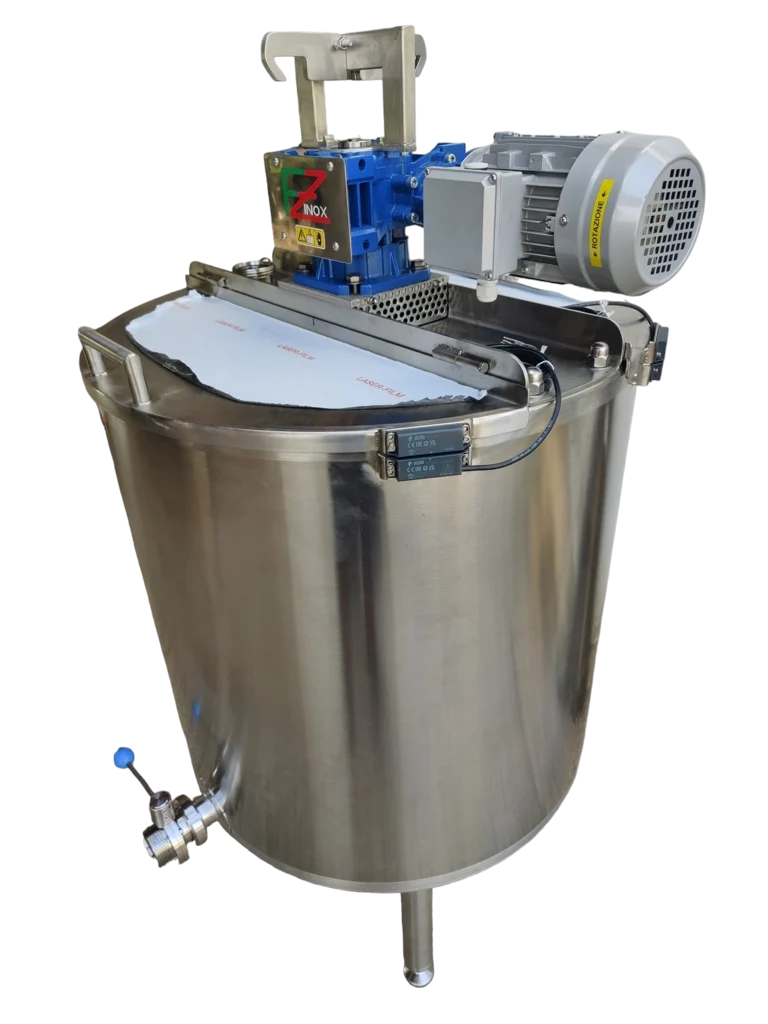
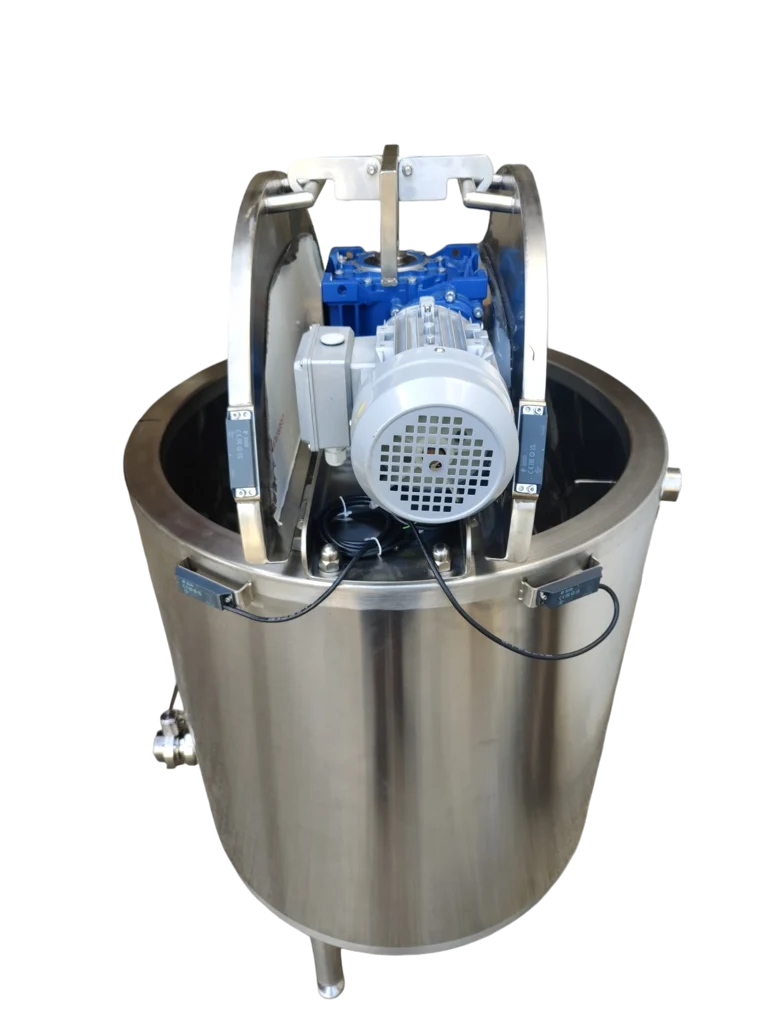
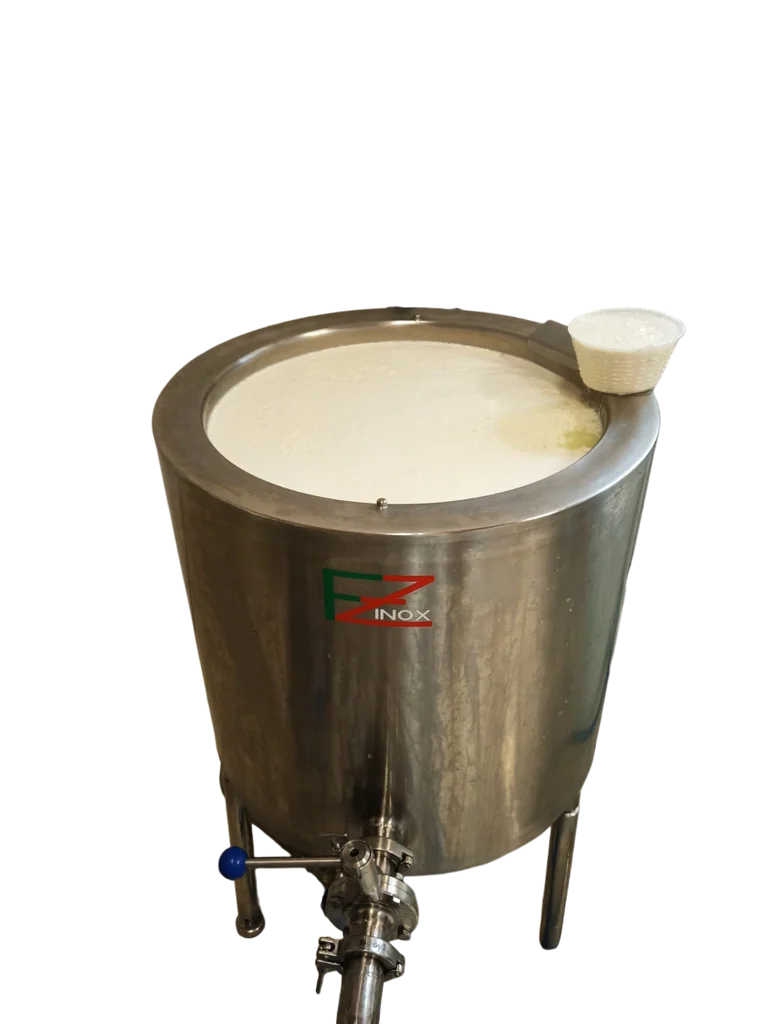
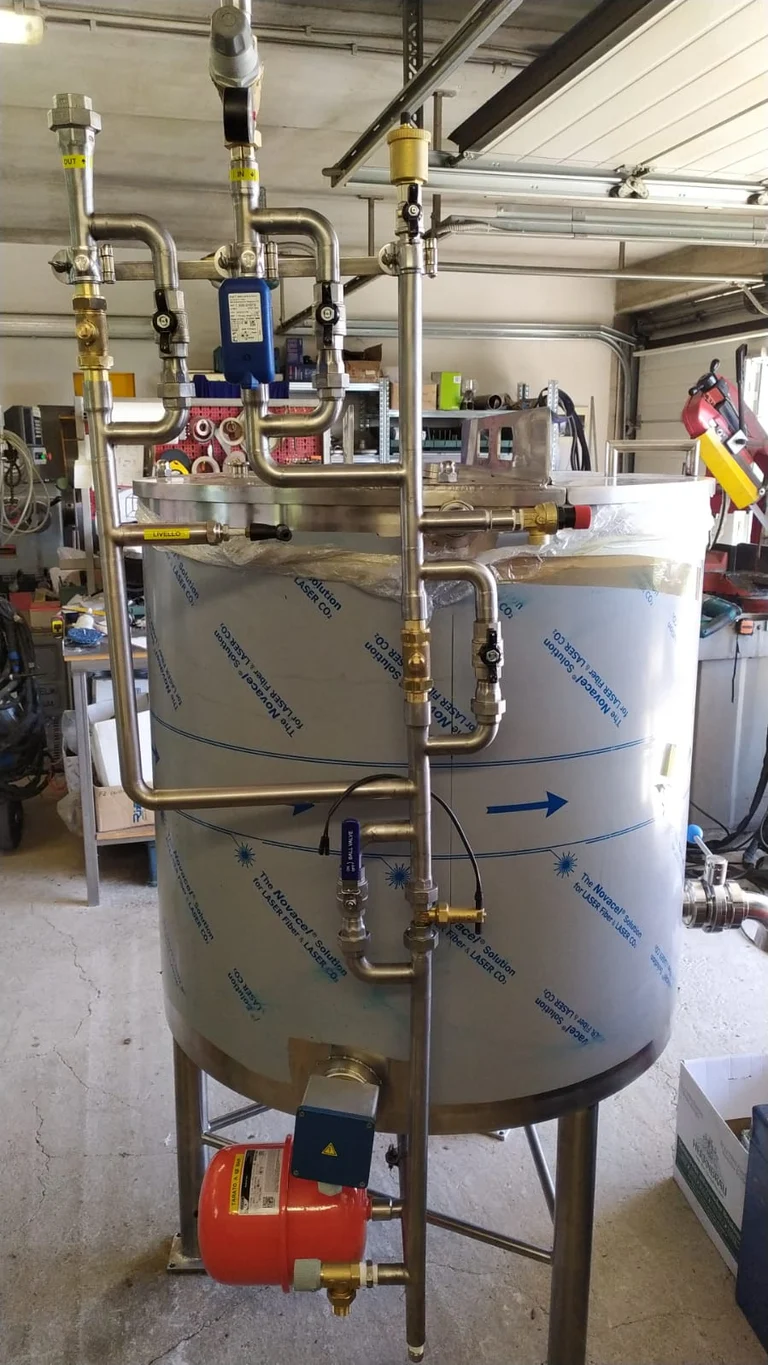
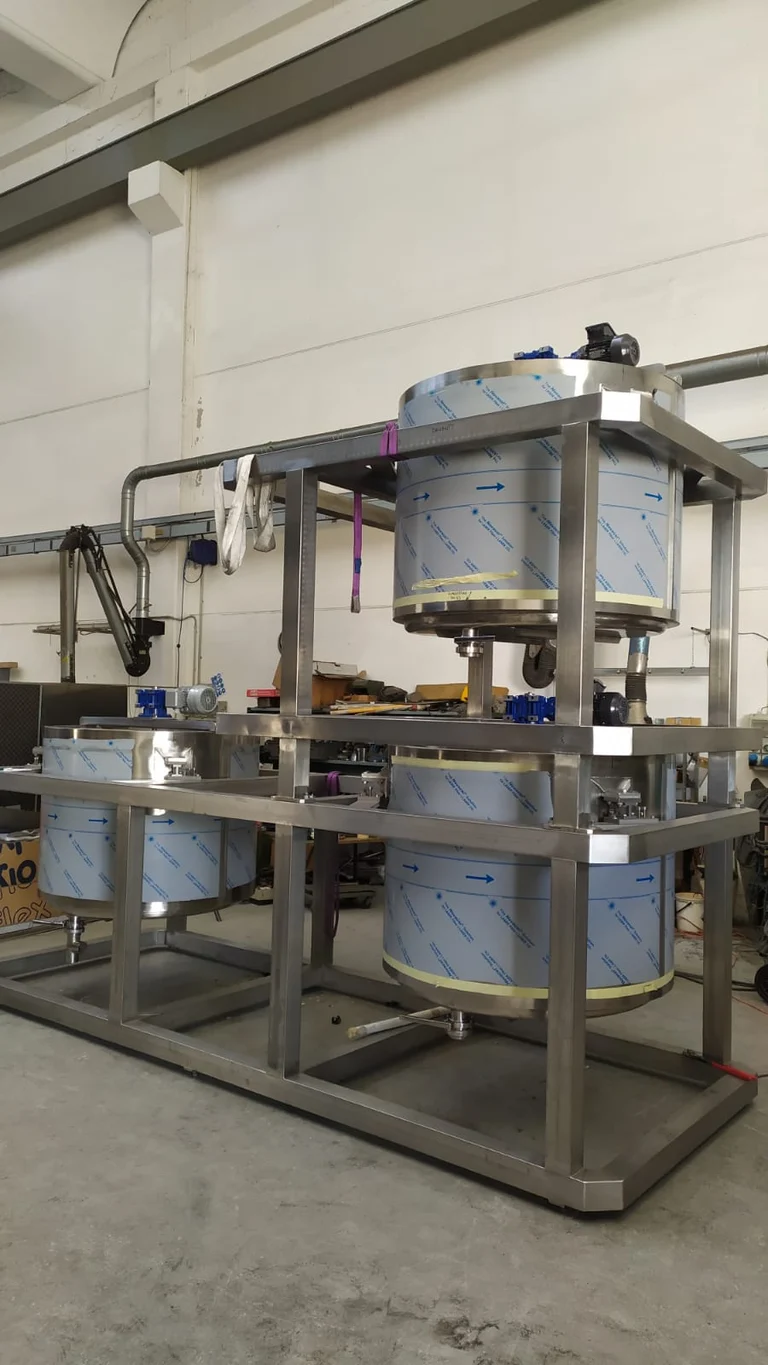
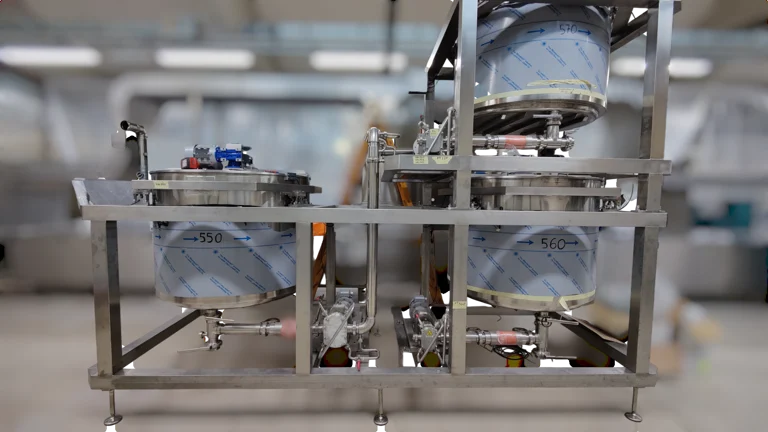
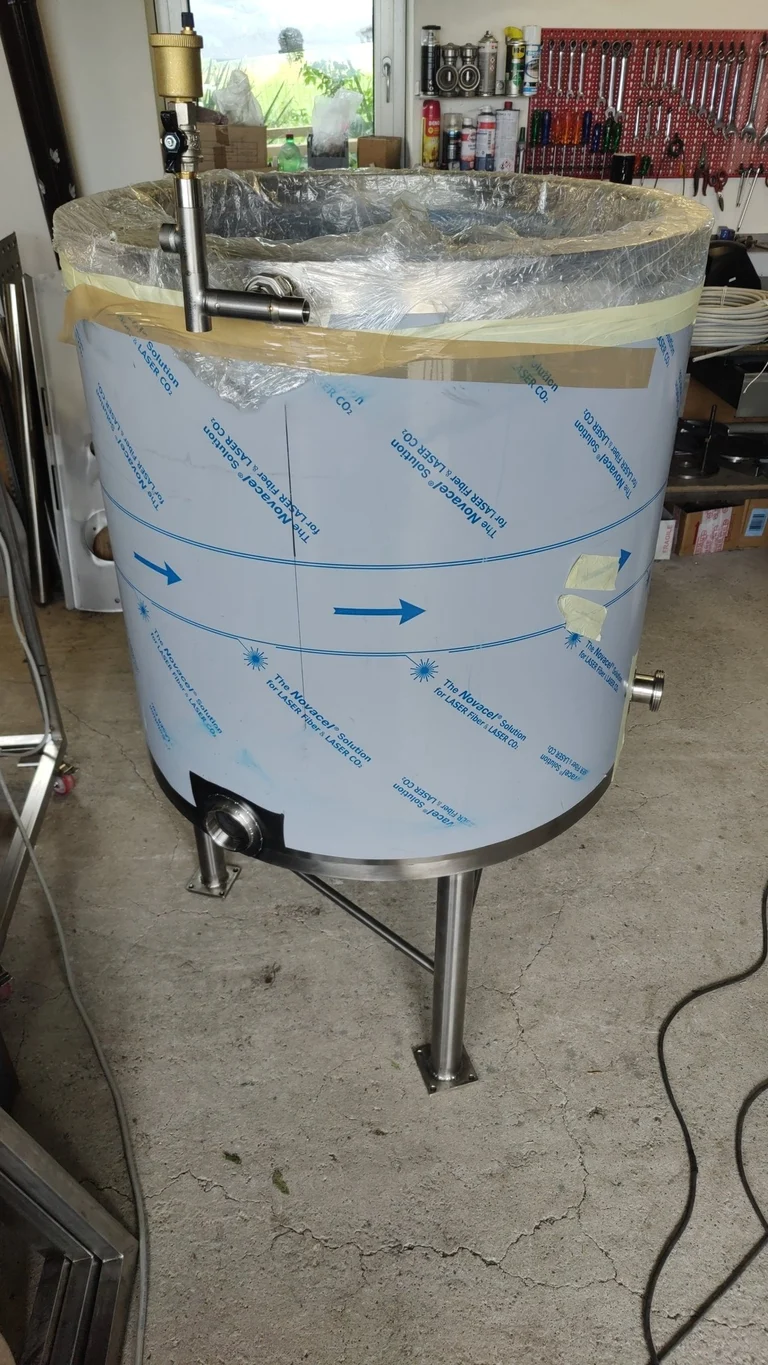
Balance tanks, 60 and 160 litres
That is what they are called, balance tanks — vaschette a livello costante in Italian — and on our pasteurisers they are the part in the middle: the product, milk for instance, comes from the storage tank, rests there, and from there it is pumped into the pasteuriser or wherever it is needed on the line.
It is not storage: it is a volume you pass through, kept small on purpose. The tank upstream does the storing. This one has a different job, and a more delicate one than it looks:
- Keeps the head constant on the pump suction
- Keeps air out of the circuit
- Prevents cavitation, which is how a pump ruins itself without anyone noticing
- Guarantees a steady flow down the line, even when the load upstream is intermittent
- Takes the product diverted by the flow diversion valve, when the temperature is not right
This is where it shows that we also build the pumps: a balance tank is drawn well by whoever knows what happens downstream when the level drops too far.
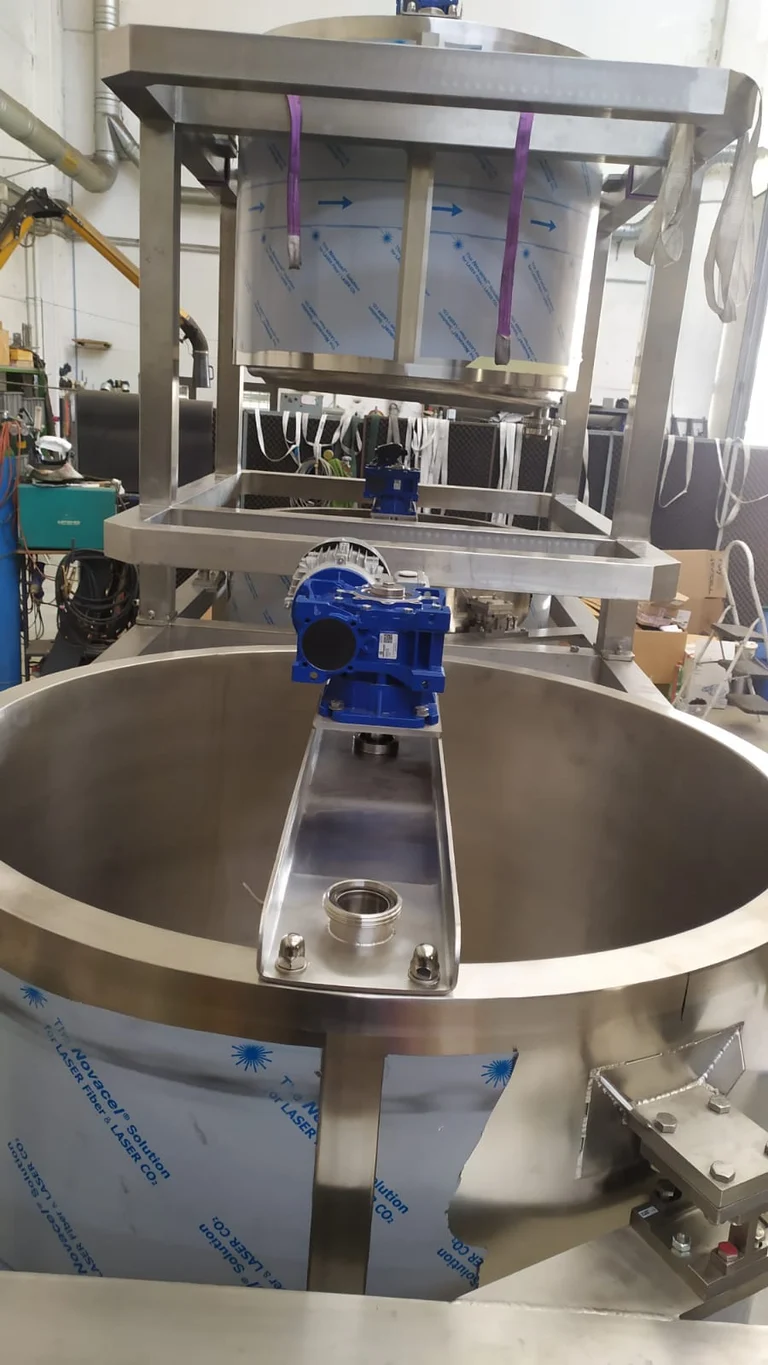
It is built like the big tanks, with the same choices of bottom, outlet and finish. Two sizes:
And this is where level really counts: a float or probes keep the balance tank at the right point, so the pasteuriser does not run dry when the storage tank is late and does not overflow when everything arrives at once.
Frequently asked
The answers we are asked for most
What sizes do you make?
Small tanks. A flat number makes no sense: for the same footprint a square holds far more than a round one, and what really counts is the space you have and the shape your process needs. Tell us the litres you need and where it has to stand: we will tell you straight away whether it fits.
Which materials are in contact with the product?
Stainless steel, AISI 304 or AISI 316, polished or satin finish. We have no house steel: it is chosen together, on the product.
The rule, in short: in dairy, 304 is the norm — it is the steel of milk tankers. 316 is justified where there are chlorides or aggressive products: brines, salted foods, white wines. 316 is not «the food-grade steel» and 304 «the industrial one»: the Italian ministerial decree on food-contact materials admits both, without restriction. The difference is molybdenum, and it works against chloride corrosion — not against milk.
Round or cornered?
It depends on one question alone: does the product have to be stirred?
If it does, round. No corners, the agitator works with the shape instead of against it, and it washes better.
If it does not, square or rectangular. It is the shape of CIP wash tanks and of storage for whatever stands still — water, products that must not be stirred. And for the same footprint it holds more litres: the capacity a round tank loses in the corners. In the calculator above, choosing the cornered shape, it makes the comparison for you in litres.
Which bottom shape suits me?
On the square there is no choice: the bottom is flat. On the round one instead: flat if the tank simply holds; conical if you have to empty it to the last drop or recover valuable product; sloped when you need to channel to the outlet without the height a cone takes up.
Can it be moved?
Yes, on castors. Otherwise adjustable feet if it stays put, or load cells if besides staying put it also has to weigh.
Can I work at a controlled temperature?
Yes, with a pillow-plate jacket: two laser-welded, inflated sheets that wrap the tank and carry hot water, glycol water or steam through it. It heats and cools. Insulation is added to the jacket when the product has to stay at temperature through long processes: the first brings the heat, the second stops you throwing it away.
How do I know how many litres I need?
If you have the space, use the calculator above: diameter and height give you the litres. If instead you have the litres and not the space, tell us how many they are and how high you can go — we will find the dimensions.
Do you build to measure?
To measure only. There is no catalogue: every tank comes out of the process, the product and the space you have.
Have you got a tank to build?
Tell us the product, the litres and the space you have. We will take care of the rest.