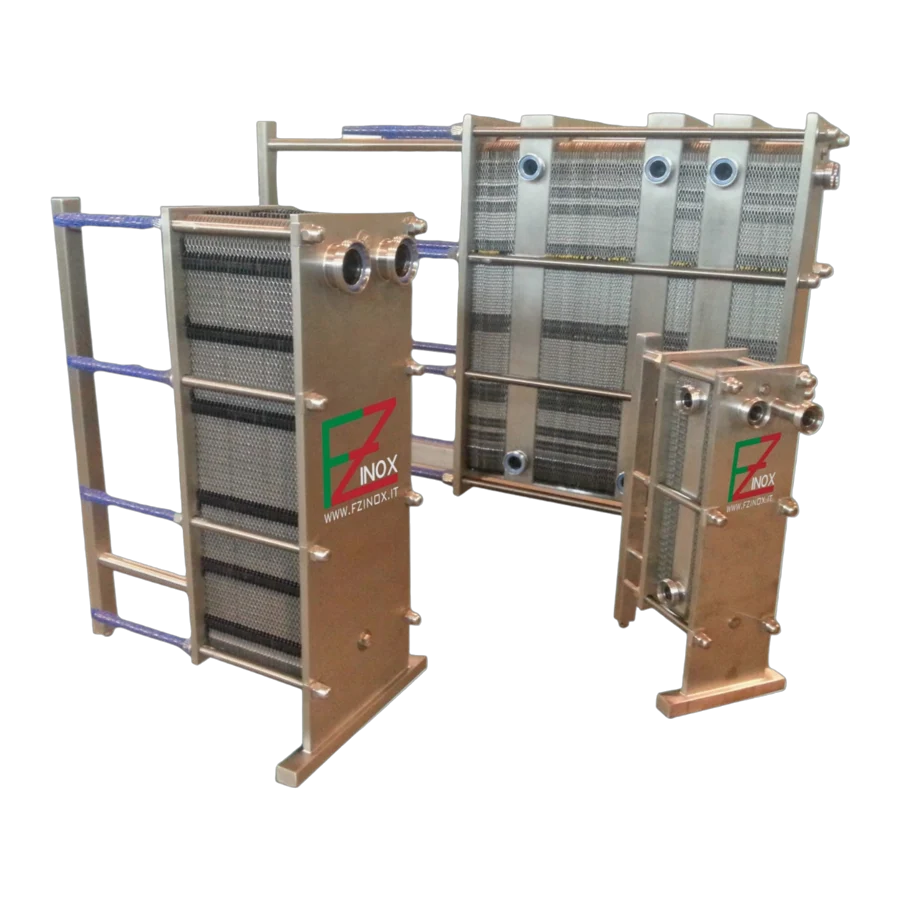
FZ INOX stainless steel plate heat exchangers deliver maximum thermal efficiency in compact dimensions — for heating, cooling and heat recovery.
Thin stainless steel plates increase the contact surface and create turbulence, boosting heat transfer while keeping the unit small and light. Plates can be added or removed to scale capacity, and disassembled easily for cleaning.
Ideal for the food, beverage and dairy industries.
Every tile is a machine we have built. Tap one to see the flow, temperature drop and thermal duty of that job.
Figures taken from real jobs, shown as worked examples. Yours will differ:
a plate heat exchanger is sized on your own flow, temperatures and product.
How heat recovery works
The hot product leaving the plant warms the cold product coming in, inside the same frame. Steam or hot water only covers the last step — which is where the saving comes from.
milk hot water well water
HEATING45 plates
RECOVERY13 plates
COOLING17 plates
1Raw milk enters the recovery pack at 4 °C
2It leaves already at 37.5 °C, warmed for free
3Hot water lifts it to 72 °C, then the holding tube
4It returns through recovery and gives its heat away
5Two passes in the same pack: out at 38 °C
6Well water brings it down to 28 °C
50% of the heat comes from the milk itself · 75 kW
50% from hot water · 76 kW
This schematic is drawn from a real calculation — a 2,000 l/h milk
pasteuriser we built, three packs of 45 + 13 + 17 plates. Temperatures, plate counts and the
recovery split are that machine's actual figures. It is shown as a demonstration of how the
three sections work together: your own layout and temperatures depend on your process.
Work out your thermal duty
Enter what you know and see the heat load your process needs. Useful before you talk to anyone — and it is the first thing we will ask you.
Thermal duty required
—
The number of plates and the transfer surface are not calculated here: they
depend on the plate pattern, the fouling factor and the pressure drop your line allows.
That part we work out for you — send us the duty above and we will size it.
Hygienic connections
DIN 11851 is our standard; the others are fitted on request so the unit drops straight into your existing line.
Connection
Sizes
Where it is used
DIN 11851
DN25 · 32 · 40 · 50 · 65 · 80 · 100
Threaded hygienic union — the food-industry standard in Italy and much of Europe
standard
Tri-Clamp
DN25 → DN100
Quick release, for lines opened often for inspection and cleaning
on request
SMS 1145
DN25 → DN100
Swedish dairy union, common on export dairy and beverage lines
on request
Flanged
DN40 → DN100 · PN16
Utilities: tower water, glycol and technical circuits
on request
Sizes are those we fit most often. If your line uses a different standard, tell us
and we build the unit around it.
Details & components
Tap any image to enlarge.
1
2
3
4
5
6
7
8
9
10
11
12
13
14
15
16
17
18
19
20
Frequently asked questions
The answers we are asked most often. Not here? Write to us.
Which materials are in contact with the product?
AISI 316L on every product-contact surface, with a polished finish for hygiene.
Which hygienic connections can I have?
DIN 11851 as standard (Italy). On request Tri-Clamp, SMS, flanges and other hygienic connections, to match your existing plant.
Do you build them to measure?
Yes — each exchanger is sized on your thermal duty: flow rates, inlet and outlet temperatures, and product.
Can it be cleaned in place (CIP)?
Yes, it is designed for CIP — cleaning in place, without dismantling.
What certifications do you have?
CE marking and Made in Italy — designed and built entirely in our Thiene (VI) workshop.
Request a quote
Need this machine for your line?
Tell us about your process — we size and build it to measure, in stainless steel.