
Plate heat exchanger: how it works and how to choose one
FZ INOX technical guide · October 2026 · from the people who build them, in Thiene, Italy
In short. A plate heat exchanger moves heat from a hot liquid to a cold one through thin stainless steel plates, without the two liquids touching. The liquids flow in alternate channels, one on each side of every plate, usually in counter-current. The plates are corrugated: the liquid becomes turbulent and exchanges a lot of heat in little space. In the food industry it is used to pasteurise, heat, cool and recover heat.
How it works
Heat always flows from the warmer body to the colder one, until the temperatures get close: the temperature difference is the engine of every heat exchanger. A plate heat exchanger puts the two liquids side by side, separated only by a thin sheet of metal, and gives the heat the shortest possible path.
The heart of the machine is the plate pack: dozens of stainless steel plates pressed with a corrugation, hung side by side and clamped between two frame plates. A gasket runs between one plate and the next: it seals the channel and decides where the liquid goes. One channel carries the product, the next the service fluid (hot water, steam, cold water, glycol water), then the product again. So every plate has the hot liquid on one side and the cold one on the other.
The liquids enter and leave through the four ports in the corners of the plates: lined up, they form the manifolds that feed all the channels of the same kind. The two liquids usually flow in counter-current, in opposite directions: this way the product can leave closer to the inlet temperature of the other liquid than parallel flow would allow.
The parts of a plate heat exchanger
- Fixed frame plate (head): the heavy plate that carries the inlet and outlet connections.
- Pressure plate: on the other side of the pack, it clamps the pack against the fixed plate.
- Tie bolts: the threaded bars that keep the pack tight. Loosen them and the exchanger opens.
- Carrying and guiding bars, top and bottom: the plates hang on them and slide along them when the pack is opened.
- Plate pack and gaskets: where the heat transfer happens. The number of plates sets the surface.
- Hygienic connections: DIN 11851 as standard on our units, DN25 to DN100; Tri-Clamp, SMS and flanges on request.
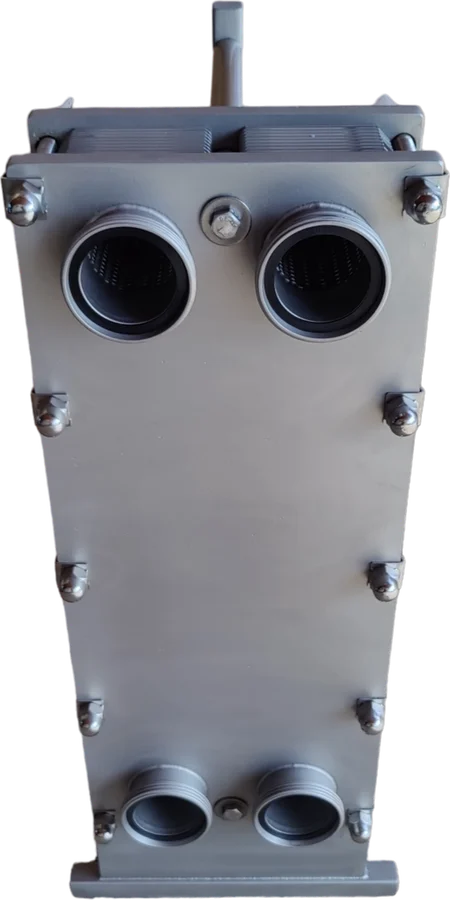
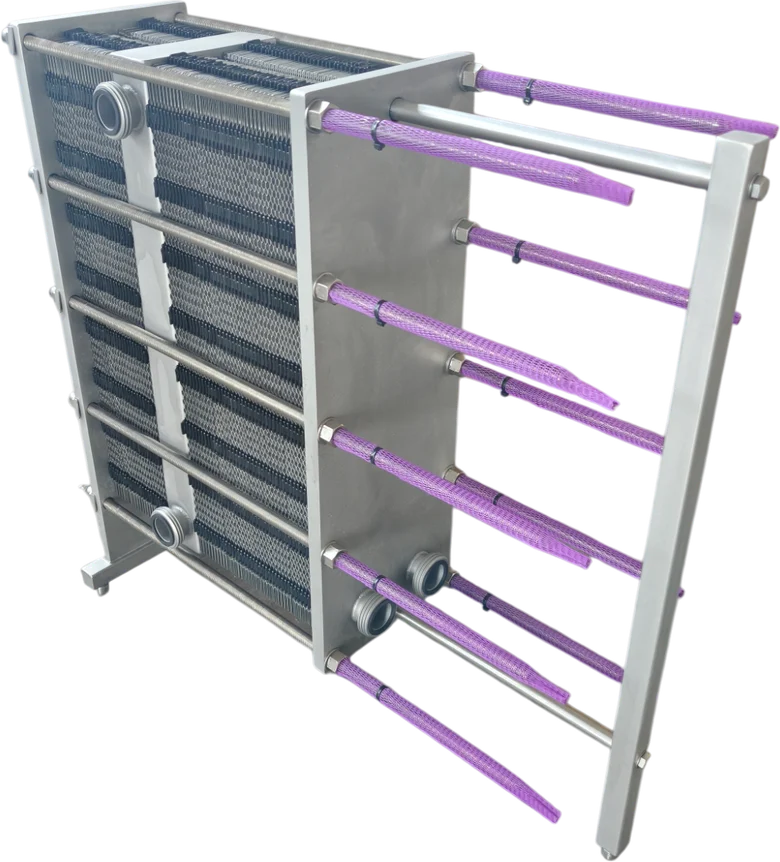
Types of plate heat exchanger
- Gasketed, can be opened: the plates are held together by tie bolts and can be taken apart, cleaned and added. This is the food-industry type, because every surface in contact with the product can be opened and inspected. It is the type we build.
- Brazed: the plates are brazed together, with no gaskets. Compact and cheap, but it cannot be opened: it is used with clean fluids, for example in heating and refrigeration systems.
- Welded or semi-welded: plates, or pairs of plates, are welded to withstand higher pressures and temperatures or aggressive fluids; only the gasketed side, if there is one, can be opened and cleaned by hand.
Why it transfers so much heat in little space
- Surface: many thin plates give a large heat-transfer surface in a small footprint.
- Turbulence: the corrugation breaks up the flow even at low flow rates; heat passes better and fouling sticks less.
- Counter-current: the two liquids meet in opposite directions and the temperature difference stays useful along the whole plate.
- Thin metal: the heat crosses only a few tenths of a millimetre of steel.
A real example: a 2,000 l/h milk pasteuriser
It is a machine we built: one frame with three plate packs, that is three sections. Temperatures and plate numbers are the real ones.
| Section | Plates | What happens |
|---|---|---|
| Recovery | 13 | Raw milk enters at 4 °C and leaves at 37.5 °C, warmed by the pasteurised milk flowing back. |
| Heating | 45 | Hot water brings the milk to 72 °C; then the milk goes through the holding tube. |
| Cooling | 17 | The pasteurised milk, leaving the recovery section at 38 °C, goes down to 28 °C with well water. |
The result: half of the heat comes from the milk itself (75 kW), the other half from hot water (76 kW). Without the recovery section the hot water would have to supply twice as much, and the cooling water would have to remove much more heat. The animated diagram is on the plate heat exchanger page.
How to calculate the heat duty
The power the exchanger has to transfer comes from three numbers: how much liquid flows, how much heat it takes to warm one kilo of it by one degree, and by how many degrees it must be heated or cooled.
Duty [kW] = flow [l/h] × density [kg/l] × specific heat [kJ/kg·K] × temperature change [°C] ÷ 3,600
Example, on the recovery section of the pasteuriser above: the pasteurised milk goes from 72 to 38 °C, that is 34 °C. With whole milk (1.02 kg/l and 3.92 kJ/kg·K):
2,000 × 1.02 × 3.92 × 34 ÷ 3,600 ≈ 75 kW
That is the 75 kW of recovered heat of the real machine. You can run the same calculation with your data in the calculator on the product page. The number of plates, on the other hand, does not come from this formula: it depends on the plate design, the fouling factor and the pressure drop your line can accept. That part we do.
How to choose one: the data you need
To size a plate heat exchanger these are the data needed. They are the first questions we will ask you:
- The product: what it is, how dense or viscous, whether it contains particles or fibres.
- The flow rate, in litres per hour.
- The product temperatures: inlet and outlet.
- The service fluid: hot water, steam, well or tower water, glycol water, and at what temperature it is available.
- The allowed pressure drop: how much pressure the line can lose across the exchanger.
- Cleaning: whether it is cleaned in place and how often.
- Connections and space on your line.
With these data we decide the number of plates, the surface and how many sections are needed. For the food industry we build plates and frame in AISI 316L.
Plate or tube-in-tube?
Plates are the most efficient choice for clean or low-viscosity liquids: milk, whey, wine, beer, soft drinks, water. With very viscous products, or products with pieces or fibres, the narrow channels between the plates foul or clog: there you need a tube-in-tube or multitube heat exchanger, which has wider passages.
Cleaning, maintenance and extension
- Cleaning in place (CIP): our plate heat exchangers are designed to be cleaned in place, without dismantling anything.
- Inspection: loosen the tie bolts, the pressure plate slides back along the guide bars and the plates can be checked one by one.
- Gaskets: they are the wearing part. Check them every time the pack is opened and replace them when they lose elasticity.
- Extension: for more capacity you add plates to the pack, up to the length of the frame.
Frequently asked questions
What is a plate heat exchanger?
It is a machine that transfers heat from a hot liquid to a cold one through thin metal plates, usually stainless steel, without the two liquids touching. The liquids flow in alternate channels between the plates.
How much heat can be recovered?
It depends on the process. In our 2,000 l/h milk pasteuriser the recovery section supplies half of the heat needed: 75 kW that would otherwise come from hot water.
Can the capacity be increased?
Yes: in a gasketed exchanger you add plates to the pack, up to the length of the frame.
Can it be cleaned in place (CIP)?
Yes. Our plate heat exchangers are designed for cleaning in place, without dismantling anything.
What are the plates made of?
For the food industry we build plates and frame in AISI 316L stainless steel.
Plate or tube-in-tube?
Plates for clean or low-viscosity liquids such as milk, wine, beer and water. Tube-in-tube or multitube for viscous products, or products with pieces or fibres, which would clog the narrow channels between the plates.
Need a plate heat exchanger? Send us product, flow and temperatures: we size it and build it in our workshop in Thiene, Italy.